> ## Documentation Index
> Fetch the complete documentation index at: https://docs.revilico.bio/llms.txt
> Use this file to discover all available pages before exploring further.
# Planning Retrosynthesis
> Plan Synthetic Routes and Pathways for Lead Compounds
## **The Problem You Are Trying to Solve**
*“I have a set of lead compounds, and I want to plan practical synthetic routes and pathways so I can prioritize what to make next.”*
 At the lead optimization stage, the best molecule on paper is only valuable if it is buildable. Synthetic planning is often constrained by:
* Limited starting material availability
* Route length, yield, and step complexity
* Risky transformations or fragile intermediates
* Cost, cycle time, and scalability considerations
This workflow helps you move from candidate SMILES → actionable synthetic routes, with clear prioritization signals across your lead set.
## **Solution**
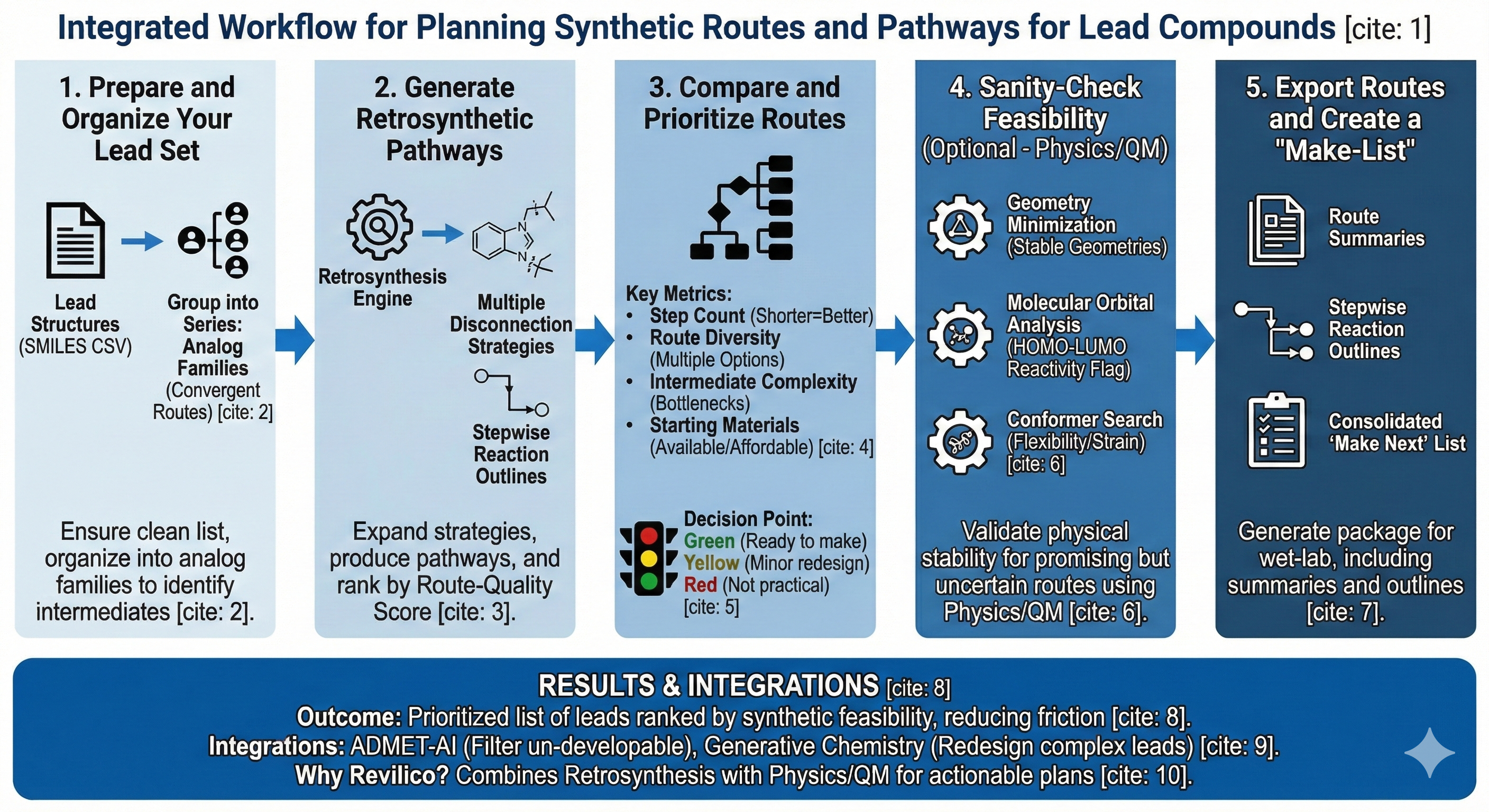
This workflow uses Revilico’s **Retrosynthesis engine** as the core route-planning layer, supported by optional feasibility and risk checks from other chemistry engines. The primary synthetic planning chain is: Lead Set Preparation → Retrosynthesis Route Generation → Route Ranking & Comparison → Starting Material & Risk Review → Export + Iterate.
Binding, property, and AI engines can be integrated to ensure you prioritize the compounds that are both valuable and makeable.
## **What Data Do I Need to Provide?**
Required
* Lead structures as SMILES (CSV upload or manual input)
Recommended
* Optional compound identifiers (name / series / project tag)
* Any “hard constraints” from your chem team (must avoid certain reagents, protect certain groups, limit step count, etc.)
Optional
* Known preferred intermediates or supplier catalogs (if your org has them)
* Target number of steps / cost ceilings / timeline constraints
## **Workflow**
1. **Prepare and Organize Your Lead Set**
Start by ensuring your lead list is clean and trackable. On Revilico, users typically:
* Upload a CSV of lead SMILES (plus optional IDs/names)
* Confirm structures are valid and standardized
* Group compounds into series (if relevant) so you can compare routes across analog families
This will give you a versioned lead set ready for route planning.
2. **Generate Retrosynthetic Pathways**
Use **Retrosynthesis** to propose diverse synthetic routes for each lead. This engine will:
* Expand multiple disconnection strategies per molecule
* Produce stepwise pathways with intermediates and reaction class labels
* Rank routes by a route-quality score (route plausibility, efficiency, starting material reasonableness)
This step answers:
* *How would I make this?*
* *How many routes exist?*
* *Which ones look most realistic?*
This will produce a ranked set of retrosynthetic pathways per lead.
3. **Compare and Prioritize Routes Across Leads**
Now shift from route generation to decision-making. Users typically review:
* Step count (shorter is usually faster and lower risk)
* Route diversity (multiple independent options reduces project fragility)
* Intermediate complexity (risk of bottlenecks)
* Starting material practicality (availability and cost proxies)
* Convergence opportunities (shared intermediates across a series)
* At this point, all of the data can be sent to your chemistry team for utilizing these newly generated hypotheses as a baseline for getting these molecules synthesized
This step is where you decide which molecules are:
* Ready to make now
* Worth minor redesign to reduce synthesis complexity
* Not currently practical relative to alternatives
This will give you a prioritized list of leads based on synthetic feasibility and route quality.
4. **Sanity-Check Molecular Feasibility and Stability (Optional)**
For routes that look promising but uncertain, validate that candidates and intermediates are physically reasonable.\
Optional supporting engines:
* **Geometry Minimization and Thermochemistry** to sanity-check stable geometries and identify strained or unstable candidates
* **Molecular Orbital Analysis (HOMO–LUMO)** to flag potentially reactive or unstable electronic profiles (helpful for identifying “looks good, but might be chemically problematic” cases)
* **Conformer Search** to highlight extreme flexibility or conformational strain that could complicate synthesis or isolation
This will give risk flags and confidence boosts on route feasibility.
5. **Export Routes and Create a Make-List**
Once routes are selected, generate outputs that enable execution:
* Route summaries per compound
* Stepwise reaction outlines and intermediates
* A consolidated “Make Next” list for your synthesis team
This step is designed to reduce handoff friction from computational planning → wet lab execution with a synthesis-ready route package and execution shortlist.
**Now what?**
* With the data on hand for planning synthesis, your chemists can now move forward with getting the molecules synthesized.
* If you are using this engine as a secondary screen to any other engine, you can utilize the results as a sanity check of the compounds to ensure that the compounds made with generative chemistry are feasible to move forward with.
## **Integration with Other Engines (Optional)**
Synthetic planning rarely happens in isolation. Revilico supports tight integration with:
* ADMET-AI + Solubility to avoid planning routes for compounds likely to fail developability
* Docking / MD / FEP to ensure synthesis effort is directed toward leads with strong on-target justification
* Generative Chemistry to redesign hard-to-make leads into more synthesizable analogs while preserving activity motifs
## **Why Revilico?**
Revilico makes synthetic planning actionable by combining:
* A dedicated retrosynthesis engine for route generation and ranking
* Optional physics/QM checks for stability and feasibility confidence
* AI-assisted interpretation to speed prioritization and iteration
* Integrations with design, screening, and optimization workflows so you can plan synthesis for the *right* compounds, not just the most interesting ones on paper.
At the lead optimization stage, the best molecule on paper is only valuable if it is buildable. Synthetic planning is often constrained by:
* Limited starting material availability
* Route length, yield, and step complexity
* Risky transformations or fragile intermediates
* Cost, cycle time, and scalability considerations
This workflow helps you move from candidate SMILES → actionable synthetic routes, with clear prioritization signals across your lead set.
## **Solution**
This workflow uses Revilico’s **Retrosynthesis engine** as the core route-planning layer, supported by optional feasibility and risk checks from other chemistry engines. The primary synthetic planning chain is: Lead Set Preparation → Retrosynthesis Route Generation → Route Ranking & Comparison → Starting Material & Risk Review → Export + Iterate.
Binding, property, and AI engines can be integrated to ensure you prioritize the compounds that are both valuable and makeable.
## **What Data Do I Need to Provide?**
Required
* Lead structures as SMILES (CSV upload or manual input)
Recommended
* Optional compound identifiers (name / series / project tag)
* Any “hard constraints” from your chem team (must avoid certain reagents, protect certain groups, limit step count, etc.)
Optional
* Known preferred intermediates or supplier catalogs (if your org has them)
* Target number of steps / cost ceilings / timeline constraints
## **Workflow**
1. **Prepare and Organize Your Lead Set**
Start by ensuring your lead list is clean and trackable. On Revilico, users typically:
* Upload a CSV of lead SMILES (plus optional IDs/names)
* Confirm structures are valid and standardized
* Group compounds into series (if relevant) so you can compare routes across analog families
This will give you a versioned lead set ready for route planning.
2. **Generate Retrosynthetic Pathways**
Use **Retrosynthesis** to propose diverse synthetic routes for each lead. This engine will:
* Expand multiple disconnection strategies per molecule
* Produce stepwise pathways with intermediates and reaction class labels
* Rank routes by a route-quality score (route plausibility, efficiency, starting material reasonableness)
This step answers:
* *How would I make this?*
* *How many routes exist?*
* *Which ones look most realistic?*
This will produce a ranked set of retrosynthetic pathways per lead.
3. **Compare and Prioritize Routes Across Leads**
Now shift from route generation to decision-making. Users typically review:
* Step count (shorter is usually faster and lower risk)
* Route diversity (multiple independent options reduces project fragility)
* Intermediate complexity (risk of bottlenecks)
* Starting material practicality (availability and cost proxies)
* Convergence opportunities (shared intermediates across a series)
* At this point, all of the data can be sent to your chemistry team for utilizing these newly generated hypotheses as a baseline for getting these molecules synthesized
This step is where you decide which molecules are:
* Ready to make now
* Worth minor redesign to reduce synthesis complexity
* Not currently practical relative to alternatives
This will give you a prioritized list of leads based on synthetic feasibility and route quality.
4. **Sanity-Check Molecular Feasibility and Stability (Optional)**
For routes that look promising but uncertain, validate that candidates and intermediates are physically reasonable.\
Optional supporting engines:
* **Geometry Minimization and Thermochemistry** to sanity-check stable geometries and identify strained or unstable candidates
* **Molecular Orbital Analysis (HOMO–LUMO)** to flag potentially reactive or unstable electronic profiles (helpful for identifying “looks good, but might be chemically problematic” cases)
* **Conformer Search** to highlight extreme flexibility or conformational strain that could complicate synthesis or isolation
This will give risk flags and confidence boosts on route feasibility.
5. **Export Routes and Create a Make-List**
Once routes are selected, generate outputs that enable execution:
* Route summaries per compound
* Stepwise reaction outlines and intermediates
* A consolidated “Make Next” list for your synthesis team
This step is designed to reduce handoff friction from computational planning → wet lab execution with a synthesis-ready route package and execution shortlist.
**Now what?**
* With the data on hand for planning synthesis, your chemists can now move forward with getting the molecules synthesized.
* If you are using this engine as a secondary screen to any other engine, you can utilize the results as a sanity check of the compounds to ensure that the compounds made with generative chemistry are feasible to move forward with.
## **Integration with Other Engines (Optional)**
Synthetic planning rarely happens in isolation. Revilico supports tight integration with:
* ADMET-AI + Solubility to avoid planning routes for compounds likely to fail developability
* Docking / MD / FEP to ensure synthesis effort is directed toward leads with strong on-target justification
* Generative Chemistry to redesign hard-to-make leads into more synthesizable analogs while preserving activity motifs
## **Why Revilico?**
Revilico makes synthetic planning actionable by combining:
* A dedicated retrosynthesis engine for route generation and ranking
* Optional physics/QM checks for stability and feasibility confidence
* AI-assisted interpretation to speed prioritization and iteration
* Integrations with design, screening, and optimization workflows so you can plan synthesis for the *right* compounds, not just the most interesting ones on paper.