> ## Documentation Index
> Fetch the complete documentation index at: https://docs.revilico.bio/llms.txt
> Use this file to discover all available pages before exploring further.
# On and Off Target Effects
> Understand On-Target and Off-Target Biological Pathway Engagement for Lead Compounds
## **The Problem You Are Trying to Solve**
*“I have a set of lead compounds, and I want to understand both their direct on-target effects and their indirect off-target effects, including how they engage broader biological pathways and cellular programs.”*
 At the lead optimization stage, it is no longer sufficient to know *that* a compound binds a target. You need to understand:
* Whether the compound robustly engages the intended target in a biologically meaningful way
* Which secondary proteins or pathways may be perturbed downstream
* Whether observed phenotypes arise from on-target mechanism, off-target liabilities, or network-level effects
* How molecular binding events translate into cellular state changes
This workflow bridges molecular-scale binding analysis with systems-level biological response modeling, helping teams move from “binds the target” to “behaves as expected in biology.”
## **Solution**
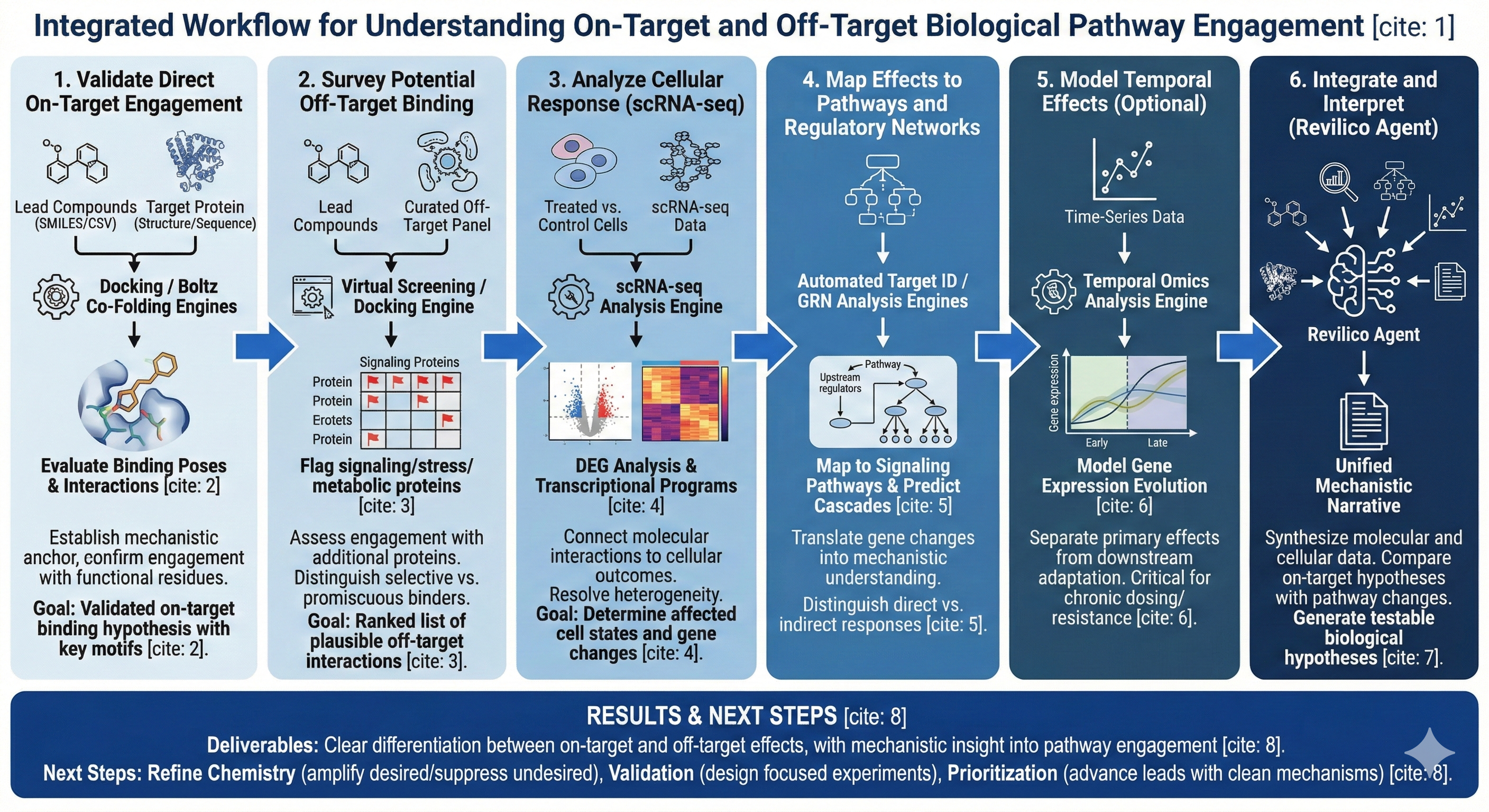
This workflow integrates binding chemistry engines with transcriptomic pathway analysis to connect molecular engagement with biological consequence. The primary analysis chain is: On-Target Binding Validation → Off-Target Binding Survey → Transcriptomic Response Analysis → Pathway & Network Interpretation.
This allows users to:
* Confirm intended target engagement
* Identify plausible off-target interactions
* Observe how cells respond to compound treatment
* Resolve whether effects are direct, indirect, or compensatory
Other engines (MD, FEP, quantum chemistry, generative chemistry) can be integrated as follow-ups once mechanisms are identified.
## **What Data Do I Need to Provide?**
Required
* Lead compound structures (SMILES or CSV)
* Primary target protein structure or sequence
* Cellular transcriptomic data (e.g., scRNA-seq) from treated vs control conditions
Recommended
* Time-resolved transcriptomic data (multiple doses or timepoints)
* Known pathway annotations for the disease context
Optional
* Off-target protein panels
* Comparative compounds (tool compounds, inactive controls)
## **Workflow**
1. **Validate Direct On-Target Engagement**
Start by confirming that leads engage the intended target in a plausible and specific manner.\
Using **Docking** and (if applicable) **Boltz or BoltzGen Co-Folding**, users:
* Evaluate binding poses and interaction patterns
* Confirm engagement of known functional residues
* Compare multiple leads for consistency of on-target binding
This step establishes a mechanistic anchor for downstream interpretation, giving a validated on-target binding hypotheses, and key interaction residues and motifs.
2. **Survey Potential Off-Target Binding**
Next, assess whether leads may engage additional proteins that could drive indirect effects. Using **Virtual Screening** and **Docking** against a curated off-target panel, users can:
* Identify secondary binding candidates
* Flag proteins involved in signaling, metabolism, or stress responses
* Distinguish selective compounds from promiscuous binders
This step generates candidate off-target hypotheses, not conclusions, in the form of a ranked list of plausible off-target interactions per lead.
3. **Analyze Cellular Response with scRNA-seq**
Now connect molecular interactions to biological outcomes. Using **scRNA-seq Analysis**, users can:
* Perform differential gene expression (DEG) analysis between treated and control cells
* Identify transcriptional programs altered by compound exposure
* Resolve heterogeneity across cell populations
This step answers:
* *What changes when the compound is applied?*
* *Which cell states are most affected?*
This results in differential expression profiles across cell types and conditions.
4. **Map Effects to Pathways and Gene Regulatory Networks**
Translate gene-level changes into mechanistic understanding. Using **Automated Target ID and Gene Regulatory Network Analysis**, users can:
* Identify upstream regulators driving observed transcriptional changes
* Map altered genes to known signaling pathways
* Predict cascade effects downstream of target engagement
This helps distinguish:
* Direct on-target pathway modulation
* Indirect off-target or compensatory responses
This step gives a pathway-level interpretation of compound effects with ranked regulators and network hubs.
5. **Model Temporal and Dose-Dependent Effects (Optional)**
If time-series data is available, deepen the analysis. Using **Temporal Omics Analysis**, users can:
* Model how gene expression evolves after compound exposure
* Identify early vs late response programs
* Separate primary effects from downstream adaptation
This step is especially valuable for:
* Chronic dosing scenarios
* Pathway rewiring and resistance studies
This produces dynamic models of pathway engagement over time.
6. **Integrate and Interpret with Revilico Agent**
Finally, synthesize results across molecular and cellular layers. Using **Revilico Agent**, users can:
* Ask mechanistic “why” questions across datasets
* Compare on-target binding hypotheses with observed pathway changes
* Generate testable biological hypotheses for follow-up experiments
This gives cohesive mechanistic narratives linking chemistry to biology.
## **Results**
* Clear differentiation between on-target and off-target effects
* Mechanistic insight into pathway-level engagement
* Reduced ambiguity in phenotypic interpretation
* Stronger confidence in lead progression or redesign decisions
## **Now What?** *I understand how my leads engage biology, but what’s next?*
Common next steps include:
* Refining chemistry to amplify desired pathways and suppress undesired ones
* Designing focused validation experiments
* Prioritizing leads with clean, interpretable mechanisms
* Integrating findings into toxicity or efficacy optimization workflows
## **Why Revilico?**
Revilico uniquely connects:
* Molecular binding engines for direct interaction analysis
* Single-cell transcriptomics for biological response resolution
* Network and temporal modeling for pathway-level insight
* AI-assisted reasoning to unify complex datasets
This enables teams to move beyond single-target thinking and design molecules with predictable, system-aware biological behavior.
At the lead optimization stage, it is no longer sufficient to know *that* a compound binds a target. You need to understand:
* Whether the compound robustly engages the intended target in a biologically meaningful way
* Which secondary proteins or pathways may be perturbed downstream
* Whether observed phenotypes arise from on-target mechanism, off-target liabilities, or network-level effects
* How molecular binding events translate into cellular state changes
This workflow bridges molecular-scale binding analysis with systems-level biological response modeling, helping teams move from “binds the target” to “behaves as expected in biology.”
## **Solution**
This workflow integrates binding chemistry engines with transcriptomic pathway analysis to connect molecular engagement with biological consequence. The primary analysis chain is: On-Target Binding Validation → Off-Target Binding Survey → Transcriptomic Response Analysis → Pathway & Network Interpretation.
This allows users to:
* Confirm intended target engagement
* Identify plausible off-target interactions
* Observe how cells respond to compound treatment
* Resolve whether effects are direct, indirect, or compensatory
Other engines (MD, FEP, quantum chemistry, generative chemistry) can be integrated as follow-ups once mechanisms are identified.
## **What Data Do I Need to Provide?**
Required
* Lead compound structures (SMILES or CSV)
* Primary target protein structure or sequence
* Cellular transcriptomic data (e.g., scRNA-seq) from treated vs control conditions
Recommended
* Time-resolved transcriptomic data (multiple doses or timepoints)
* Known pathway annotations for the disease context
Optional
* Off-target protein panels
* Comparative compounds (tool compounds, inactive controls)
## **Workflow**
1. **Validate Direct On-Target Engagement**
Start by confirming that leads engage the intended target in a plausible and specific manner.\
Using **Docking** and (if applicable) **Boltz or BoltzGen Co-Folding**, users:
* Evaluate binding poses and interaction patterns
* Confirm engagement of known functional residues
* Compare multiple leads for consistency of on-target binding
This step establishes a mechanistic anchor for downstream interpretation, giving a validated on-target binding hypotheses, and key interaction residues and motifs.
2. **Survey Potential Off-Target Binding**
Next, assess whether leads may engage additional proteins that could drive indirect effects. Using **Virtual Screening** and **Docking** against a curated off-target panel, users can:
* Identify secondary binding candidates
* Flag proteins involved in signaling, metabolism, or stress responses
* Distinguish selective compounds from promiscuous binders
This step generates candidate off-target hypotheses, not conclusions, in the form of a ranked list of plausible off-target interactions per lead.
3. **Analyze Cellular Response with scRNA-seq**
Now connect molecular interactions to biological outcomes. Using **scRNA-seq Analysis**, users can:
* Perform differential gene expression (DEG) analysis between treated and control cells
* Identify transcriptional programs altered by compound exposure
* Resolve heterogeneity across cell populations
This step answers:
* *What changes when the compound is applied?*
* *Which cell states are most affected?*
This results in differential expression profiles across cell types and conditions.
4. **Map Effects to Pathways and Gene Regulatory Networks**
Translate gene-level changes into mechanistic understanding. Using **Automated Target ID and Gene Regulatory Network Analysis**, users can:
* Identify upstream regulators driving observed transcriptional changes
* Map altered genes to known signaling pathways
* Predict cascade effects downstream of target engagement
This helps distinguish:
* Direct on-target pathway modulation
* Indirect off-target or compensatory responses
This step gives a pathway-level interpretation of compound effects with ranked regulators and network hubs.
5. **Model Temporal and Dose-Dependent Effects (Optional)**
If time-series data is available, deepen the analysis. Using **Temporal Omics Analysis**, users can:
* Model how gene expression evolves after compound exposure
* Identify early vs late response programs
* Separate primary effects from downstream adaptation
This step is especially valuable for:
* Chronic dosing scenarios
* Pathway rewiring and resistance studies
This produces dynamic models of pathway engagement over time.
6. **Integrate and Interpret with Revilico Agent**
Finally, synthesize results across molecular and cellular layers. Using **Revilico Agent**, users can:
* Ask mechanistic “why” questions across datasets
* Compare on-target binding hypotheses with observed pathway changes
* Generate testable biological hypotheses for follow-up experiments
This gives cohesive mechanistic narratives linking chemistry to biology.
## **Results**
* Clear differentiation between on-target and off-target effects
* Mechanistic insight into pathway-level engagement
* Reduced ambiguity in phenotypic interpretation
* Stronger confidence in lead progression or redesign decisions
## **Now What?** *I understand how my leads engage biology, but what’s next?*
Common next steps include:
* Refining chemistry to amplify desired pathways and suppress undesired ones
* Designing focused validation experiments
* Prioritizing leads with clean, interpretable mechanisms
* Integrating findings into toxicity or efficacy optimization workflows
## **Why Revilico?**
Revilico uniquely connects:
* Molecular binding engines for direct interaction analysis
* Single-cell transcriptomics for biological response resolution
* Network and temporal modeling for pathway-level insight
* AI-assisted reasoning to unify complex datasets
This enables teams to move beyond single-target thinking and design molecules with predictable, system-aware biological behavior.