

The Problem You Are Trying to Solve
“I have a set of lead compounds, and I want to optimize them across multiple developability dimensions, like solubility, ADME, toxicity, and related properties, without losing on-target potency.”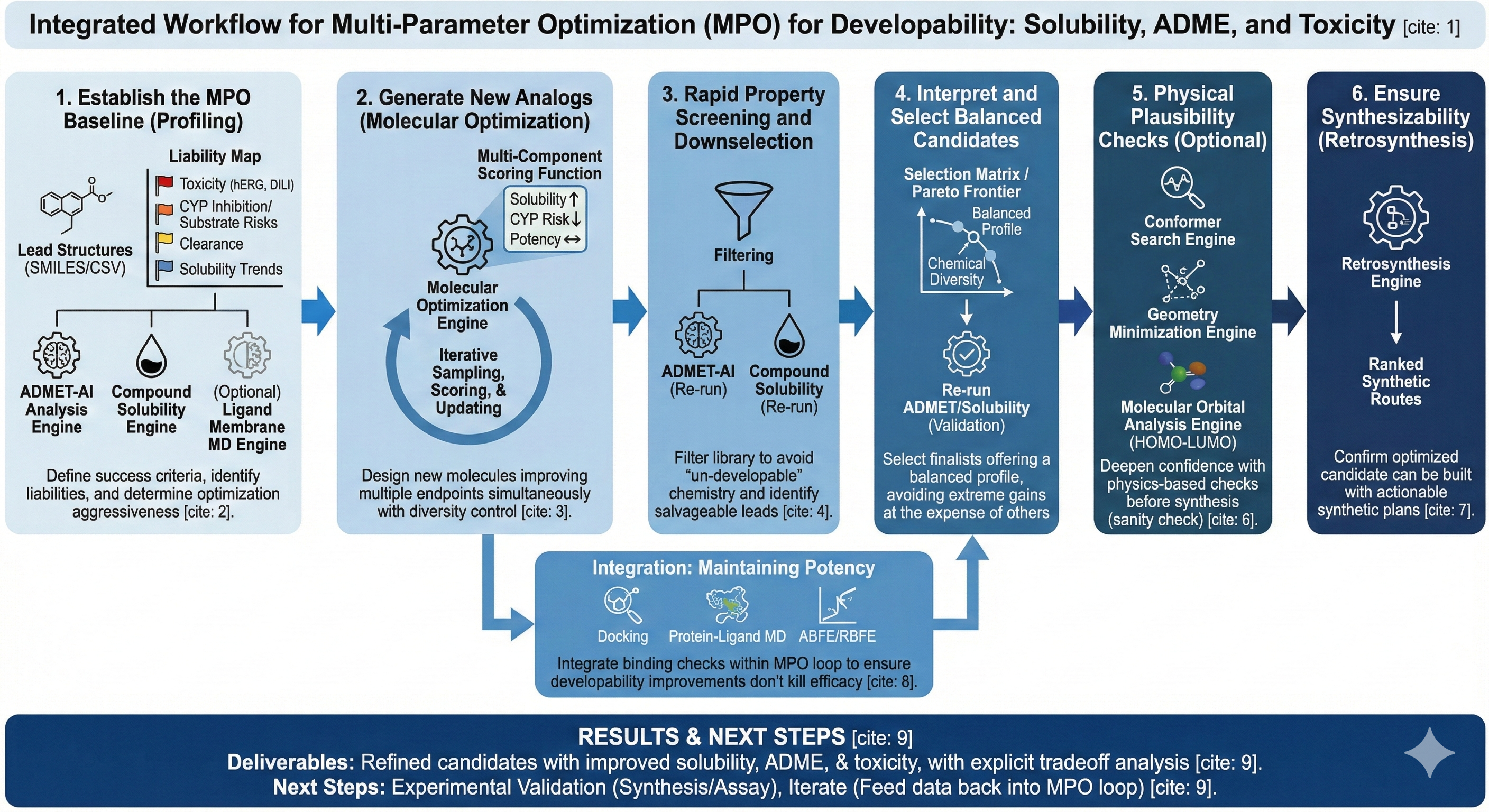
- A potent binder may be insoluble or poorly permeable
- A promising series may carry CYP liabilities, hERG risk, or DILI flags
- Small structural changes can meaningfully shift clearance, bioavailability, or safety
Solution
This workflow uses a primary MPO loop that alternates between:- Designing new analogs with the right constraints
- Scoring them across developability endpoints
- Filtering for synthesize-ability and feasibility
- Repeating until a balanced set emerges
What Data Do I Need to Provide?
Required- Lead structures (SMILES / CSV)
- Your desired optimization targets (examples: “increase solubility, reduce CYP3A4 inhibition risk, maintain MW < 500”)
- Optional hard constraints (avoid specific motifs, preserve pharmacophore features, keep series scaffold)
- Experimental solubility/clearance/tox data (if available)
- On-target structure/assay signals for potency anchoring
Workflow
- Generate New Analogs Using Multi-Objective Molecular Optimization
- Generate analogs from the existing leads (conservative or exploratory)
- Ensure that there is proper activity of your ligands to the target of interest during this process
- Encode MPO goals as a multi-component scoring function (e.g., solubility ↑, CYP risk ↓, hERG risk ↓, MW/LogP constraints, etc.)
- Apply diversity controls so you don’t get 1,000 near-duplicates
- Establish the MPO Baseline
- Run ADMET-AI Analysis to surface the major liabilities (toxicity flags, CYP inhibition/substrate risks, clearance risk, permeability proxies)
- Run Compound Solubility to understand baseline solubility trends across solvents and temperature
- You can run the Ligand Membrane MD Engine that will allow you to analyze permeability of the compound to different seeded cell membranes
- (Optional) Run Conformer Search or other quantum methods to understand flexibility and shape drivers that may impact permeability and exposure
- Which liabilities matter most
- Which constraints must remain fixed
- How aggressive optimization should be
- Rapid Property Screening and Downselection
- ADMET-AI Analysis to identify red flags early (toxicity, CYP panels, hERG/DILI risk, clearance risk, permeability)
- Compound Solubility to identify which leads have a solubility ceiling that must be addressed by design
- which leads are salvageable
- which liabilities are dominant
- which properties move together vs trade off
- Interpret and Filter Results
- Prefer compounds with consistent ADMET improvements (not one extreme gain paired with new liabilities)
- Avoid candidates that only score well due to compensation effects
- Maintain chemical diversity among finalists to reduce risk of series-level blind spots
- ADMET-AI Analysis (re-run on the new library) for confirmation
- Compound Solubility (re-run for top candidates) to validate solubility gains
- Check Conformations, Electronic Risk, and Physical Plausibility (Optional)
- Conformer Search to ensure the compounds can adopt relevant 3D shapes without extreme strain
- Geometry Minimization and Thermochemistry to confirm stable geometries and rule out unstable/high-energy structures
- Molecular Orbital Analysis (HOMO–LUMO) for electronic reactivity signals (useful for flagging unstable/reactive chemistry)
- Ensure Synthesizability with Retrosynthesis
- Propose ranked synthetic routes
- Flag candidates with unrealistic or costly synthesis pathways
- Prioritize compounds that are both better and buildable
Results
- A refined set of candidates improved across solubility, ADME, and toxicity dimensions
- Explicit tradeoff awareness (what improved, what worsened, and why)
- Higher confidence in which compounds are worth synthesis and assays
- A repeatable MPO loop you can run iteratively as new data arrives
Integration with Other Engines (Optional)
If potency/selectivity must be enforced within the MPO loop, users can integrate:- Docking / Virtual Screening to maintain binding hypotheses while improving developability
- Protein–Ligand MD to validate binding stability for optimized candidates
- ABFE/RBFE for high-confidence ranking among close analogs
Why Revilico?
Revilico enables MPO as a single connected loop:- Generative design (Molecular Optimization) grounded in explicit scoring
- Fast developability screens (ADMET-AI, Solubility) to guide iteration
- Physical plausibility checks (Conformer Search, QM engines) for confidence
- Buildability validation (Retrosynthesis) to ensure real-world feasibility