

“I have a known drug (ligand) and a target (protein) complex with demonstrated efficacy, and I want to identify which cell line will show the best therapeutic response based on its molecular profile.”
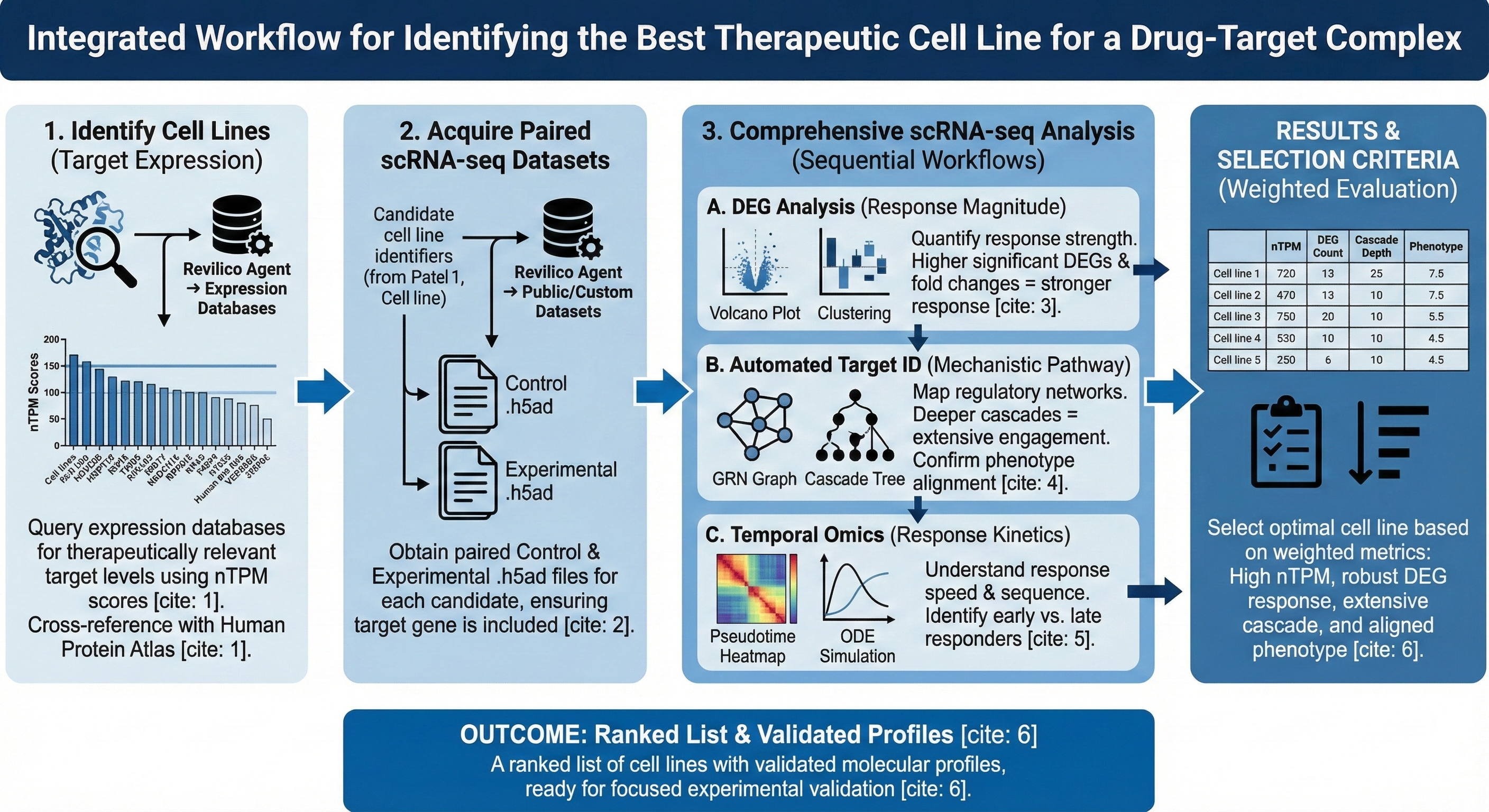
This workflow enables users to a) systematically identify cell lines with optimal therapeutic response potential through target expression profiling and b) comprehensively characterize the molecular mechanisms driving drug efficacy using multi-modal transcriptome analysis across Revilico’s scRNA-seq Analysis Engine. We leverage three complementary analytic workflows, DEG Analysis for response magnitude assessment, Automated Target ID for regulatory network mapping, and Temporal Omics for response kinetics to ensure complete characterization of cellular response dynamics. What Data Do I Need to Provide?
- Protein name or identifier (Required to identify cell line candidates to evaluate)
- Identify Cell Lines based on Target Expression
- Acquire Paired scRNA-seq Datasets
- Run Comprehensive scRNA-seq Analysis
- List of candidate cell lines and their associated nTPM scores
- A panel of scRNA seq datasets corresponding to the candidate cell lines
- DEG Analysis plots (Volcano Plots, Clustering Visualizations, Differential expression gene lists)
- Automated Target ID plots (GRN Graphs, Cascade trees, phenotype bar graphs)
- Temporal Omics (Pseudotime heatmaps, Trajectory plots, ODE simulation results)
- Why Revilico?
The goal of this workflow is to systematically identify the cell line that will show the best therapeutic response for a drug-target complex based on its molecular profile before moving into costly experimental tests. This is achieved by first identifying candidates based on target expression (nTPM scores) and then running a comprehensive multi-modal scRNA-seq analysis (DGE, Automated Target ID, Temporal Omics) to characterize the molecular mechanisms driving drug efficacy.